What is a Geoportal?
A Geoportal is a gateway to Web-based geospatial information and information services. It enables you to discover, view and access geospatial information and services made available by their sources. Likewise, if you are a source of such information and services it enables you to make your geospatial information and services discoverable, viewable and accessible by others.
A Geoportal maintains a repository of metadata - data about the geospatial data or services you are seeking to discover or make available. Each metadata "record" in the repository describes the nature and scope of a registered data "item" or service, and provides information that enables you to locate and view each registered item or service within the Geoportal. The metadata descriptions also provide the information necessary to access items and services for use within other systems or mapping applications.
In brief, you can use the Geoportal to:
- Discover geospatial information resources
- View details about each discovered resource, including how to get it for your own use
- Immediately view Live Data and Map resources you have discovered
- Create, upload and manage metadata that references geospatial data items and services your organization has produced
- Manage and update your own user account information
- Manage and save queries you have created for use during subsequent sessions
What is the Geoportal Extension 9.3.1 SP1?
ESRI's Geoportal extension Version 9.3.1 SP1, is a suite of software modules that together provide the capability to build and custom-configure Geoportals to meet each implementing entity's particular style, needs, and use objectives.
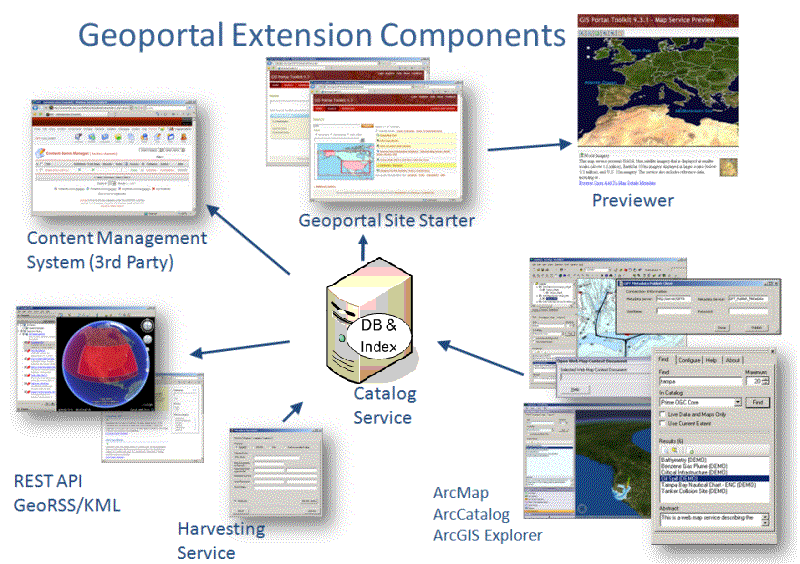
The suite of software modules includes the following (for more details about the Geoportal Exension architecture, see Components of the Geoportal extension:
- A customizable Geoportal module (the principal interface and capability for publishing, administering, and searching metadata)
- A live data previewer map interface for viewing live data and services
- A desktop metadata Harvesting Tool and Harvesting Service for accessing original or updated metadata from participating metadata publishers for posting to the Geoportal module
-
Integration with content management systems to organize metadata to support focused user communities
-
Data extraction service customization for downloading data for a resource, with the ability to specify an extent, projection and download format
- Search results exposed through the REST API so records can be easily shared among applications and users
-
CSW Client, a freely downloadable extension for ArcMap and ArcGIS Explorer to enable searching Geoportal catalogs from within those environments
-
Publish Client, a freely downloadable extension for ArcCatalog that enables Geoportal publisher users to publish metadata from an ArcCatalog directory to the Geoportal
-
WMC Client, a freely downloadable extension for opening saved web map context files in ArcMap
In addition to providing the ability to administer Geoportal management functions and seamlessly communicate with data services that use a wide range of communication protocols, the Geoportal extension enables users to publish metadata in conformance with a variety of metadata standards, query metadata records for relevant data and services, and link directly to the online sites that host the data services referenced and described by the metadata. The Geoportal extension also enables those who implement it to establish user community communication capabilities, visualize referenced data as maps, and use referenced data in geographic queries and analyses.